

 Pas d'avant les domestiques Pas d'avant les domestiques
  since
since
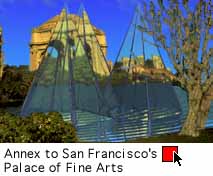
 In the San Francisco of 2032, Mouse lived between Multimedia Gulch and the Embarcadero in the neighborhood south of Market called SoMa. His loft on Berry close to Ritch was on the third floor of one of those narrow, tall warehouses that look like the old TransAm building with a front passageway, a dark, dangerous, winding staircase, and not more than three windows on each floor. Within they have a courtyard, or to be more precise, an airshaft. Above the three or four partitions of the space occupied by Keene was his studio, which looked out onto the bay. The studio had tastefully exposed brick, a polished floor carefully stained maple. Each chair had a souvenir pillow and the davenport, though simple, was as neatly vacuumed as if it were in the bedroom of a dentist's wife. The whole place indicated the meticulous way of life of a small-minded man and the carefulness of a poor one. There was a chest of drawers for putting away the studio materials, a dining table, a sideboard, a desk and, finally, the tools that an artist needs, all tidily arranged.
His computer fitted appropriately into this system of old-skool carefulness that could be seen all the more clearly in the pure, unchanging light from the north that filled the enormous loft with its clear, cold brightness. Mouse, a simple genre painter, doesn't need those enormous systems that ruin multimedia artists. He never thought himself gifted enough to tackle a large installation and restricted himself to work on a single screen.
To celebrate the New Year, the city bourgeois conceive the strange idea of immortalizing their faces (though there is already a bit too much of them). In the winter of the year in question, Mickey Keene, having gotten up early, was preparing his palette, adjusting his thermowave, eating a roll dipped in milk, and waiting for the frost on his window panes to thaw so that the light could come through and he could start work. It was a fine, dry day. The artist was eating, with that patient and resigned look that reveals so much, when he recognized the step of a man who had influenced his life as this kind of person influences the lives of nearly all artists. It was Ulysses Magus, an art dealer and speculator in digital prints. He took the painter by surprise, just as he was going to start work in his clean and tidy studio.
 How are you, you old rogue ?
 asked the painter. Mouse had become a member of the Academy of Visual Applications and since Ulysses used to buy his pictures for five- or even eight-hundred dollars, he put on airs of being very much the artist.
Business is bad, answered Ulysses. You all ask for so much nowadays. You talk of five-hundred dollars as soon as you have output two bit's worth of dye onto CanvaSham . But you are a good fellow, you are! You are a well-organized man and I have come to bring you a good deal.
Timeo Danaos et dona ferentes, said Mouse. Do you know Latin?
Are you kidding? No.
Well, that means that the Greeks don't make good business suggestions to the Trojans without making something out of it themselves. In the past, the Greeks used to say, 'Take my horse,' today they say, 'Take my advice.' What do you want, Ulysses Itshak Bruno Magus? These words show the formality and wit with which Mouse used what the painters call the studio approach.
I am not saying that you won't do two pictures for me for nothing.
Uh-oh!
I leave you to decide; I am not asking for them. You are an honest artist.
Come to the point!
Well, am going to bring you a father, a mother, and an only daughter.
Each one is an only!
Certainly, yes. And all with portraits to be painted. These Masters of the Universe are crazy about the arts, and they never dared venture into a studio. The girl will soon begin to receive a hundred-thousand yearly from her trust fund. You might well paint these people. For you perhaps they wil1 one day be family portraits. The old German woodcarving who passes for a man and is called Ulysses Magus, interrupted himself with a dry laugh that frightened the painter. It was as if Le Stat were suggesting marriage.
The portraits will pay fifteen-hundred each. You can do three pictures for me later.
Sure, said Mouse laughingly.
And if you marry the girl, you won't forget me.
Me, get married! exclaimed Mickey. I am used to going to bed quite alone and to getting up very early. I have my life all organized.
A sweet girl with one-hundred thousand dollars, said Magus, and hair full of gold tints like a real Titian.
What do these people do?
He's a retired CFO. For the moment, they love the arts, have a country house at Russian River, and interest on a bunch of million a year.
What was his business?
Bioplastics.
Don't say that. It makes me smell that Orgplasm we used at school and my breakfast will be coming up.
Shall I bring them?
Three portraits. I'll exhibit them in the Show. I'll be able to make a career in portraits. All right, yes.
0ld Ulysses went downstairs to fetch the Bobbit family. In order to appreciate how this proposal was going to influence the painter and what impression my lord and lady Bobbit accompanied by their only daughter were to make on him, we must glance back at the past life of Mickey Keene of Anaheim.
as a pupil
Mickey had studied drawing in the studio of Osaka Williams who, in the digital world, was considered to be a great draftsman. After two years Keene's ability began to approach competent. Then, he went to Schinner to discover the secrets of the powerful, magnificent color mapping that distinguishes that master. Both the master and his other pupils had been discreet. Mouse had found out nothing there. From there, Mouse had gone on to Sommervieux's studio, to acquaint himself with that branch of his art called Composition. But Composition was shy and did not reveal herself to him. After that he had tried to grasp the mysteries of lighting and surface from Whitney and Drolling. Following his first exam project he was refunded his remaining tuition. Finally, after a deflected stab at programming with Madame Duval Porta, Mouse had declined further efforts at education.
During these studies in these different environments, Mickey lived in a quiet and orderly manner that was laughed at in the different studios where he worked. But everywhere his fellow students were disarmed by his modesty and by his mouse-like patience and gentleness. The master artists had no sympathy for this worthy fellow. The masters liked the brilliant pupils, the unusual minds, or the witty, the passionate, the gloomy and deeply thoughtful ones who show signs of future talent.
 Everything about Mouse proclaimed his mediocrity. Even his surname of Keene occasioned several insulting remarks. But, mostly he was called by the name of the biggest star in the town where he'd first seen the light, although it did not seem he would ever be as well-regarded.
Mouse looked like his name. Thin and of medium build, he had an insipid complexion, dishwater hair, a turned-up nose, a fairly wide mouth and protruding ears. The only element that shone at all were his small, dark, watery eyes. These main features of his healthy, but inexpressive, countenance were not enhanced by his gentle, passive and resigned look. He was obviously not tormented by that superabundant vitality, by that violent intellectual activity, nor by that comic verve that is the mark of the great artist. This young man, born to be a virtuous middle-class icon, had come from his home town to be a clerk at Flax, selling painters' materials.
He came from Bakersfield stock, was a distant relative of a former child star, and it was obdurate Californian optimism that made him set himself up as a painter. What he suffered, how he lived during his student days, Buddha alone knows. He suffered as much as great men suffer when they are harassed by poverty and hunted like wild beasts by the pack of mediocrities and the troops of Vanity thirsting for vengeance. As soon as he thought he was strong enough to fly with his own wings, Mouse took a studio at the top of the Terminal Hotel apartments where he began to slog away. He made his debut in 2015. The first picture that he offered to the selection committee for the Academy Show represented a vector-traced version of a small town holiday, and it was quite painstakingly copied from a Rockwell painting.
 |
 Turn the pages of the story Turn the pages of the story  |
| Balzac Bonus: artSavant 3D Tile "Bars & Stripes" |
| Return to the top of the page |
Ready to go to the artSavant 3D Primer?
How about a look at the artSavant 3D gallery?  Maybe you'd like to explore other icons without labels?
*This page and its pictures ©1999 artSavant.